
WordPress vs Custom Website: Which Is Better for Your Business?
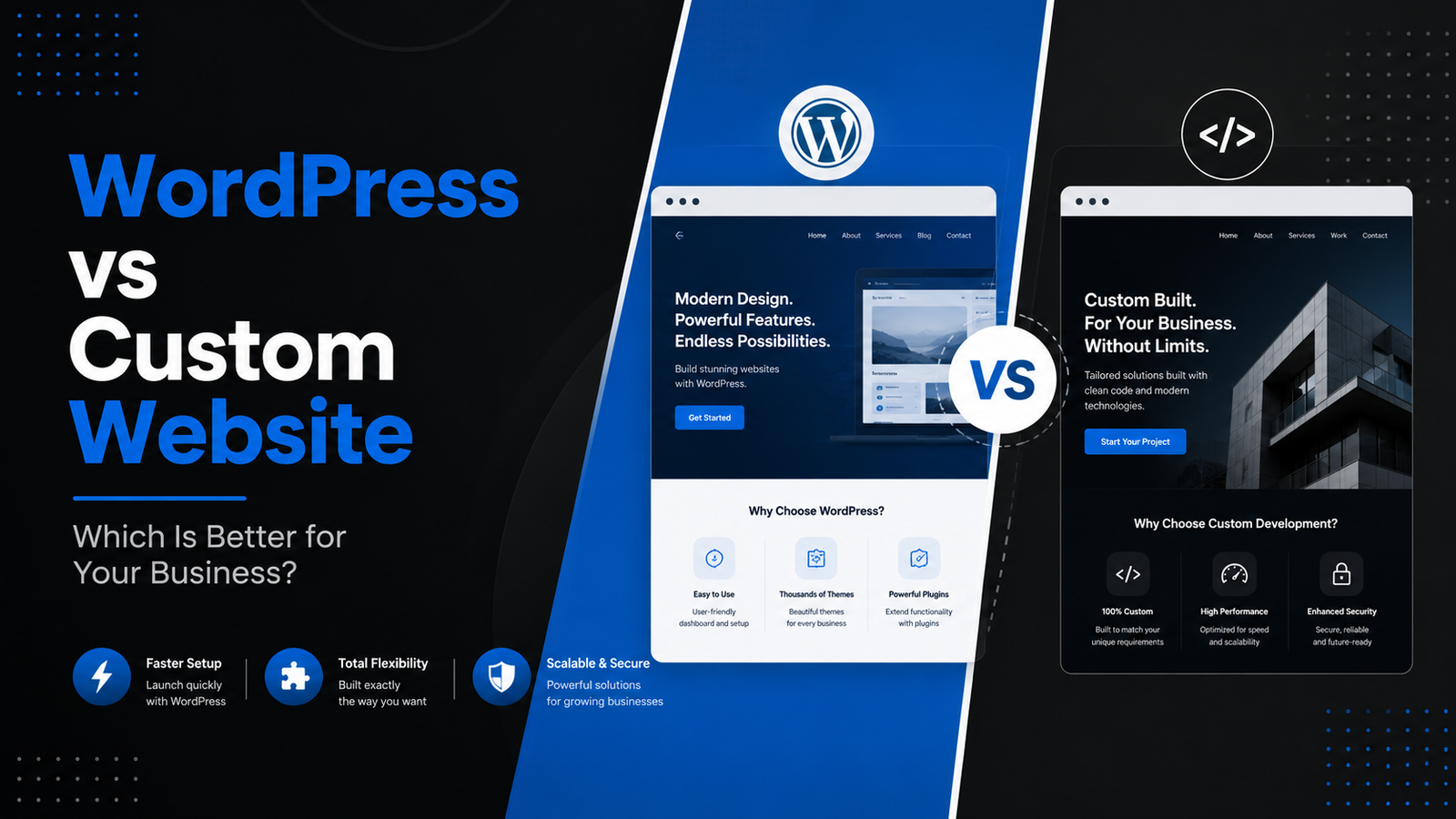
Choosing the right website direction is easier when the advice is practical, honest and connected to real business goals. This guide explains WordPress vs custom website in a way that helps you make a confident decision without relying on vague promises.
What Is a WordPress Website?
A WordPress website is built on the WordPress content management system. It can use themes, plugins, custom code and page builders such as Elementor to create editable business websites, blogs, portfolios and ecommerce stores.
What Is a Custom-Coded Website?
A custom-coded website is built with a tailored codebase instead of relying primarily on a CMS. It can be fully custom, but usually requires more development time and technical maintenance.
WordPress vs Custom Website: Quick Comparison
| Factor | WordPress | Custom Website |
|---|---|---|
| Cost | Often more affordable for standard business needs. | Usually higher for unique systems. |
| Development time | Faster for common websites. | Longer because more is built from scratch. |
| Editing | Business users can manage content more easily. | May require custom admin tools. |
| Flexibility | Very flexible within WordPress ecosystem. | Maximum flexibility if budget allows. |
| Maintenance | Requires updates for core, themes and plugins. | Requires developer-led maintenance. |
| Ecommerce | WooCommerce works well for many stores. | Best for highly unique ecommerce logic. |
| Performance | Can be fast if built carefully. | Can be highly optimized when engineered well. |
| Ownership | You own your site but rely on WordPress components. | You own the custom code if contract says so. |
Advantages of WordPress
- Faster launch for common website types.
- Large plugin ecosystem.
- Editable content management.
- Good fit for blogs, service pages and many ecommerce stores.
- Easier handover for non-technical owners.
Limitations of WordPress
WordPress can become slow or hard to maintain if too many plugins are used, if the theme is poorly built, or if custom requirements are forced into unsuitable plugins.
Advantages of Custom Development
Custom development is strong when the project needs unique workflows, unusual integrations, complex dashboards or product-like functionality that WordPress would struggle to support cleanly.
Limitations of Custom Development
Custom websites often need a larger budget, longer timeline and ongoing developer support. Editing content may be harder unless a custom CMS is built.
Which Is Better for Small Businesses?
For many small businesses, WordPress is the practical choice because it balances cost, speed and content management. A custom website makes sense only when the business has needs that cannot be handled cleanly with WordPress.
Which Is Better for Ecommerce?
WooCommerce is a strong option for many ecommerce stores. Custom ecommerce may be better for marketplaces, complex inventory systems, unusual checkout logic or large-scale platforms.
Which Is Better for Large or Complex Platforms?
Large platforms should decide based on technical requirements, user roles, integrations, scalability and long-term product roadmap. WordPress is not automatically wrong, but it should be evaluated honestly.
Questions to Ask Before Choosing
- Will your team need to edit content?
- How custom are the required features?
- What is the launch timeline?
- What is the maintenance budget?
- Will ecommerce be simple or complex?
- Who will manage updates after launch?
Final Recommendation by Project Type
| Project Type | Recommended Direction |
|---|---|
| Service business website | WordPress is usually suitable. |
| Portfolio or personal brand | WordPress is usually suitable. |
| Standard ecommerce store | WordPress with WooCommerce can be suitable. |
| Complex SaaS platform | Custom development is often better. |
| Unique internal system | Custom development may be better. |
Frequently Asked Questions
Is WordPress better than a custom website?
It depends on the project. WordPress is better for many standard business sites, while custom development is better for highly unique systems.
Is WordPress secure?
WordPress can be secure when updated, configured properly and supported by trusted themes and plugins.
Can WordPress handle ecommerce?
Yes. WooCommerce supports many ecommerce needs, but very complex stores may need custom planning.
Is a custom website faster?
It can be, but performance depends on development quality. A poorly built custom website can also be slow.
Which option is easier to manage?
WordPress is usually easier for non-technical content editing.
Need Help Choosing the Right Website Platform?
If you are unsure whether WordPress or custom development fits your business, review my website services and share your requirements.
Explore Services | Discuss the Project
How to Make the Platform Decision
The right decision between WordPress and custom development comes from requirements, not preference. If the website needs standard pages, a blog, service sections, portfolio and manageable content editing, WordPress is often practical.
If the project behaves more like a software product with custom user dashboards, complex permissions, unique workflows and heavy integrations, a custom-coded system may be a better foundation.
A balanced WordPress vs custom website decision should consider cost today and maintenance tomorrow. A cheaper build that cannot scale or a complex custom build that the team cannot manage can both become expensive.
Questions for Your Internal Team
- Who will update content after launch?
- How often will pages change?
- Do you need ecommerce, booking, membership or dashboards?
- What integrations are required now or later?
- Is launch speed more important than full custom control?
- Do you have budget for ongoing developer support?
Maintenance Reality Check
WordPress maintenance usually includes plugin updates, theme updates, backups and performance checks. Custom websites also need maintenance, but the work is often handled directly by developers.
Neither option is maintenance-free. The question is which maintenance model fits your budget, team and future plans.
Practical Notes Before You Start
A good website decision should be based on audience, business model, content quality, technical requirements and the way the site will be managed after launch. The design is important, but the structure behind that design is what makes the website useful over time.
For most businesses, the best approach is to start with a clear version-one scope. Build the pages and features that support real customer action first, then improve the website as the business learns from visitor behavior and customer feedback.
Mobile experience deserves special attention. Many visitors will not patiently zoom, pinch or search through crowded layouts. Buttons, forms, menus, product cards, text size and page speed should all be reviewed on real mobile widths before launch.
Content is another common bottleneck. A developer can create the structure, but the business still needs clear service descriptions, product details, policies, images and trust-building information. Preparing these early reduces delays and improves the final result.
What to Prepare Before Contacting a Developer
- A short summary of your business and audience.
- The main goal of the website or page.
- Required pages, features and forms.
- Existing website URL if there is one.
- Brand assets, images and content drafts.
- Reference websites and design preferences.
- Timeline, budget range and support expectations.
How to Review the Finished Work
When the work is ready for review, check more than the homepage. Test navigation, mobile layout, forms, important buttons, page speed, image loading and whether the content can be edited easily.
Ask for a short handover explanation if you will manage the site yourself. Knowing how to update text, images, products or blog posts can save time after launch.
Detailed Planning Guide for This Topic
A strong decision about wordpress vs custom website should begin with discovery. Discovery means understanding the business model, target audience, key services or products, visitor objections, required actions and the type of trust signals the website needs.
The next step is page planning. Even a small website benefits from a clear structure: homepage, about, service or product pages, contact page, policy pages where needed and blog content if search visibility matters. Without structure, design becomes decoration instead of communication.
Content planning should happen before final design. Headings, short paragraphs, benefit statements, FAQs and calls to action shape how users move through a page. If content is weak, even a visually polished design can feel unclear.
Responsive design should be treated as a requirement, not an extra. A layout that looks good on a large monitor can fail on a phone if text is too large, buttons are too close, images crop badly or forms are uncomfortable to complete.
Performance planning is also part of professional website work. Image size, hosting quality, plugin choices, scripts, fonts and animations all affect loading. A premium-looking website should still feel fast and stable.
Basic SEO should be built into the structure. This does not mean keyword stuffing. It means clear URLs, useful headings, descriptive page titles, internal links, helpful content, optimized images and pages that answer the visitor’s real question.
Trust signals must be honest. A website can use process details, portfolio examples, transparent service descriptions, FAQs and contact information without inventing testimonials, awards or unrealistic statistics.
Maintenance should be discussed early. WordPress websites need updates, backups, plugin review and occasional content changes. A site that is easy to maintain is more valuable than a site that only looks impressive during delivery.
Client-Side Questions to Clarify
- What is the main business goal behind this website or page?
- Who is the ideal visitor and what problem are they trying to solve?
- What action should visitors take after reading the page?
- What pages, sections or features are essential for launch?
- What content, brand assets and images are already available?
- Which features can wait until a later improvement phase?
- Who will manage updates after delivery?
- How will success be reviewed after launch?
Developer-Side Quality Checks
A developer should check layout consistency, mobile spacing, button visibility, form behavior, image loading, heading hierarchy and internal links before delivery. These details are easy to miss when a project is judged only by the homepage.
For WordPress projects, the dashboard experience matters too. The owner should be able to update common content without breaking the layout. If a website is difficult to edit, future changes become slower and more expensive.
A professional review also includes plugin discipline. Every plugin should have a purpose. Adding many plugins for small visual effects can make the website harder to maintain and slower over time.
How This Applies to Bangladesh-Based and International Clients
Bangladesh-based businesses often need mobile-first layouts, clear contact options, local delivery or payment explanations, and sometimes bilingual Bangla-English content planning. These should be discussed before design starts.
International clients may care more about remote communication, timezone-friendly updates, documented scope and a smooth review process. The core website quality requirements remain the same: clarity, trust, speed and maintainability.
Whether the client is local or international, the website should not depend on unsupported claims. Clear service descriptions and useful content usually build stronger trust than exaggerated promises.
Common Review Mistakes
- Reviewing only desktop design and ignoring mobile.
- Approving pages before checking forms and buttons.
- Using oversized images because they look sharp on one screen.
- Adding too many animations without considering performance.
- Publishing vague content that does not answer customer questions.
- Ignoring ongoing maintenance and plugin updates.
- Forgetting to add internal links between related pages.
A Practical Next Step
If this topic matches your current website plan, write down your goal, required pages, must-have features and any examples you like. That short brief will make the project conversation more productive.
You can also compare your needs with the current Services page and then send a focused message through the Contact page. A clear first message usually leads to a clearer quote and a smoother project.
Final Pre-Launch Review Checklist
Before publishing any website or major page, review it like a first-time visitor. The page should explain the offer quickly, show the next action clearly and remove avoidable confusion. This review is especially important for business owners who are close to the project and may overlook basic visitor questions.
Also check the operational side. If the website has a form, submit a test message. If it has a store, place a test order. If it has service pages, confirm that the contact links work. A clean launch is not only about design; it is about making sure the website can actually support business conversations.
- Main message is clear above the fold.
- CTA buttons link to the right page.
- Images load clearly without heavy delay.
- Mobile layout is readable and easy to tap.
- Forms, checkout or inquiry paths have been tested.
- Important pages are internally linked.
- Basic SEO title, description and excerpt are prepared.